Yacht Reference
Shamrock IV: The 1920 America's Cup Challenger
A neutral historical reference on Sir Thomas Lipton's challenger, the yacht that pushed Resolute to a five-race match in 1920.
By Amalfi Yacht Charter Editorial
Published May 22, 2026
Historical reference
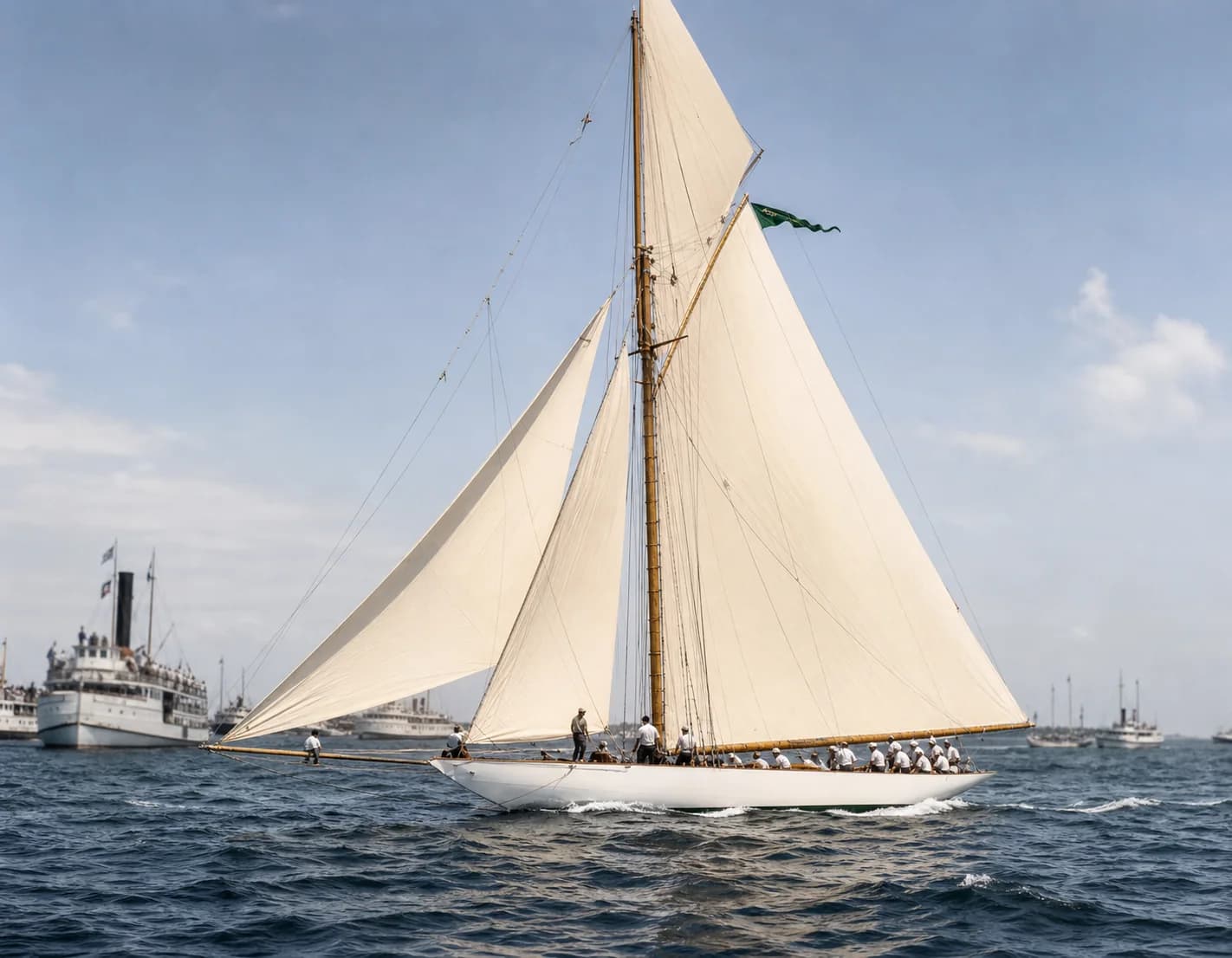
At A Glance
- Name
- Shamrock IV
- Role
- 1920 America's Cup challenger
- Owner
- Sir Thomas Lipton
- Designer
- Charles Ernest Nicholson
- Opponent
- Resolute
- Result
- Lost to Resolute, 3-2
- Campaign
- Delayed by the First World War
- Historical value
- One of Lipton's closest Cup challenges
Overview
Shamrock IV was Sir Thomas Lipton's challenger for the 1920 America's Cup, designed by Charles Ernest Nicholson and remembered for bringing Lipton closer to victory than a simple losing result suggests. The yacht ultimately lost to Resolute by three races to two, but the sequence of the match matters. Shamrock IV won the first two races, placing the American defender under immediate pressure before Resolute recovered.
The yacht's history is shaped by delay. Shamrock IV was associated with a challenge interrupted by the First World War, and the match was not completed until 1920. That interruption matters because the boat belonged to a prewar design and sporting world, yet she competed in the changed atmosphere after the war. The result is a yacht whose story cannot be reduced to dimensions or scoreline alone.
For Lipton, Shamrock IV was part of a long and public pursuit of the Cup. His challenges made him one of the best-known figures in America's Cup history, even though the trophy never came to Britain under his ownership. Shamrock IV's early lead in 1920 gave the campaign a rare moment of apparent breakthrough. That is why the yacht remains historically interesting despite defeat.
Design And Campaign Context
Charles Ernest Nicholson designed Shamrock IV in an era when America's Cup yachts were large, specialized, and shaped by rating rules as much as by open-water intuition. A challenger had to combine speed, balance, and reliability while crossing into a competitive environment controlled by the defender's club, local conditions, and established American sailing practice.
The challenge also carried symbolic weight. Lipton's campaigns were public events, not private experiments hidden from view. Newspapers, yacht clubs, and spectators followed the effort as a contest between British ambition and American defense. Shamrock IV therefore had to bear more than sailing pressure. She carried the hopes of a long-running challenge narrative.
The war delay complicated every part of that story. Yachts age, crews change, public attention shifts, and technical assumptions can become less certain over time. When Shamrock IV finally raced in 1920, she was not simply a new challenger meeting a new defender. She was a delayed project entering a revived international sporting stage.
The 1920 Match Against Resolute
Shamrock IV's strongest historical claim is the way she opened the 1920 match. By winning the first two races, she created one of the more dramatic starts to an America's Cup challenge. A 2-0 lead did not guarantee victory, but it changed the emotional shape of the series. The defender was no longer merely expected to win; Resolute had to recover.
The American defender did recover, winning the next three races and retaining the Cup. For Shamrock IV, that final result is frustrating precisely because the opportunity had seemed real. She did not lose as a token challenger. She forced the match into a five-race contest and made the defender's eventual victory feel earned rather than automatic.
That tension is important for historical reference. A yacht can lose and still matter. Shamrock IV matters because she reveals how close Lipton's challenge came, how uncertain Cup defense could feel during a live match, and how much a final score can hide about the changing fortunes of a series.
Lipton's Long Pursuit Of The Cup
Shamrock IV cannot be separated from Sir Thomas Lipton's long pursuit of the America's Cup. Lipton's challenges were not one-off sporting curiosities. They formed a public campaign that made him one of the most recognizable figures in Cup history. His yachts carried national interest, personal ambition, business visibility, and a genuine desire to win a trophy that had resisted British challengers for decades.
That persistence gives Shamrock IV a meaning beyond her own hull. She was part of a sequence, and readers should understand that sequence before judging the 1920 result. A challenger named Shamrock IV already carried the weight of earlier attempts. The name suggested continuity and determination. It also reminded observers that Lipton had come back again, despite previous defeats and despite the difficulty of beating the New York Yacht Club on its own competitive ground.
Lipton's public image also shaped the way the challenge was received. He was often treated with admiration even when he lost, partly because his repeated attempts gave the Cup a human narrative that extended beyond technical design. Shamrock IV therefore sits at the meeting point of engineering and personality. She was a racing machine, but she was also the vessel through which Lipton's reputation, optimism, and frustration were made visible.
For a historical reference page, this matters because the yacht's significance is not captured by the phrase lost to Resolute. Many yachts lose races and disappear from public memory. Shamrock IV remains notable because the loss came after an unusually promising start and because it belonged to Lipton's broader story of persistence. The emotional dimension should be acknowledged without turning the article into legend.
Charles Ernest Nicholson And Challenger Design
Charles Ernest Nicholson's role gives Shamrock IV a technical identity distinct from Lipton's ownership. A challenger was never simply the owner's dream translated into canvas. It required a designer capable of reading the rule, anticipating defender strengths, and producing a yacht that could cross the Atlantic and race in American waters. Nicholson worked within a demanding environment in which reputation, cost, and national expectation converged.
A Cup challenger had to answer a different problem from a defender. The defender could rely on local knowledge, institutional continuity, and a selection process within the defending club. The challenger had to arrive from outside, adapt to the racing ground, and prove that its design assumptions held up under unfamiliar pressure. Shamrock IV's early success in 1920 suggests that Nicholson's design was not a ceremonial entry. It was capable of putting the defender in real difficulty.
The design questions were not abstract. Sail area, hull form, ballast, rig strength, and crew handling all had to function together. The yacht needed enough power to threaten Resolute, but not so much that she became unmanageable. She needed to be specialized, but not fragile. She needed to exploit the rule, but also survive the practical demands of match racing. These tensions define the technical world in which Shamrock IV should be read.
Nicholson's contribution is therefore part of the yacht's historical value. The article should not reduce Shamrock IV to Lipton's optimism or to a British challenge label. It should recognize that she was a serious design response to a serious defender, and that her performance in the opening races deserves technical respect even though the final series went the other way.
A Challenge Interrupted By War
The First World War changed the timeline of Shamrock IV's challenge and gave the yacht a complicated historical position. She belonged to a prewar challenge that could not be completed in its expected moment. When racing resumed, the world around the Cup had changed. The delay affected public attention, crew preparation, technical maintenance, and the atmosphere in which international sport returned.
A yacht delayed by war is not merely paused like a document in a drawer. Large racing yachts require care, funding, skilled maintenance, and renewed coordination. Sails, spars, fittings, and crew routines all matter. Even if the basic design remains intact, the campaign around it has to be reassembled. Shamrock IV's eventual performance in 1920 should therefore be read against the difficulty of reviving a challenge after interruption.
The delay also adds poignancy. Lipton had waited through years in which the original competitive moment disappeared. When Shamrock IV finally raced, she carried the residue of that waiting. Her opening victories must have felt like confirmation that the long interruption had not destroyed the campaign's possibility. Her later defeat made the missed opportunity feel sharper.
This war-shaped context is essential for a durable reference article. Without it, Shamrock IV becomes only a challenger that lost three races to two. With it, she becomes a yacht whose competitive life was stretched across a historical fracture. That is a far richer and more accurate way to understand her place in America's Cup history.
Why The First Two Wins Matter
Shamrock IV's first two wins are the center of her historical significance. They changed the match from an expected defense into a crisis for Resolute. A challenger that takes an early lead forces everyone to reconsider assumptions: the defender's supporters, the press, the crews, and later historians. Those wins are why Shamrock IV should be treated as a serious Cup subject rather than a footnote.
In a best-of-five series, a two-race lead creates a narrow corridor for the opponent. Resolute had to win every remaining race. Shamrock IV needed only one more. That mathematical pressure matters because it changes behavior. Crews may become more conservative or more aggressive. Tactical choices can become heavier. Equipment concerns feel larger. A match that once seemed open becomes a test of nerve as much as speed.
The fact that Shamrock IV did not complete the victory should not erase the importance of the lead. Historical writing often overvalues final outcomes and undervalues the state of a contest while it was being lived. In the moment after the second win, Shamrock IV had made the Cup vulnerable. That temporary vulnerability is a real historical fact, even if it did not become a permanent transfer of the trophy.
A careful article should preserve that moment. It should explain that Shamrock IV's importance lies not only in losing narrowly but in forcing the defender into recovery. Resolute's comeback and Shamrock IV's challenge are two halves of the same story. The challenger created the difficulty that made the defender's victory memorable.
Crew, Handling, And Match Pressure
The crew dimension is easy to overlook when a yacht is discussed mainly through owner, designer, and result. Yet a large Cup challenger under a powerful rig depended on coordinated human labor. Sail handling required strength, timing, and judgment. Every maneuver translated design into action. A yacht that looked fast in profile still had to be kept in balance by sailors working under race pressure.
Shamrock IV's early wins imply more than a promising design. They imply a campaign capable of sailing the yacht effectively enough to beat Resolute twice. That does not happen by accident. Crews had to understand trim, acceleration, helm feel, and the relationship between tactical choices and the yacht's physical limits. A challenger arriving from outside the defender's home environment faced the added burden of adaptation.
The later reversal also belongs to this human story. A match can turn because of conditions, decisions, tuning, or the defender improving faster than the challenger. It can also turn because the psychological load changes. Protecting a lead is different from chasing one. Shamrock IV's crew had to carry the pressure of being close to something Lipton had pursued for years.
For modern readers, this is one of the best ways to make the yacht vivid without inventing detail. We do not need to claim private conversations or undocumented onboard moments. The structure of the match itself shows the pressure. A challenger two races up in the America's Cup is no longer simply competing; it is standing near the edge of history.
Shamrock IV And Resolute As A Shared Story
Shamrock IV and Resolute should be read together. Each yacht explains the other. Shamrock IV gave the match its danger; Resolute gave the match its recovery. If the challenger had been easily beaten, Resolute's defense would seem routine. If Resolute had not recovered, Shamrock IV would be remembered as the yacht that finally delivered Lipton the Cup. The actual history depends on both possibilities being present.
This paired reading helps avoid a common problem in Cup history: treating winners as complete stories and challengers as failed attempts. A challenger can lose and still define the match. Shamrock IV defined the 1920 match by making the defender vulnerable. Her place in the narrative is not secondary decoration. It is structural.
The pair also reveals the international character of the Cup. Resolute represented the American defense tradition and Herreshoff's mature authority. Shamrock IV represented British challenge, Nicholson's design work, and Lipton's persistence. The series became a meeting of design cultures and sporting expectations. That is why it continues to reward more than a short database entry.
A replacement reference link should therefore help readers move beyond the final score. The useful question is not just who won. It is how the match became uncertain, why that uncertainty mattered, and how the yachts created the drama together. Shamrock IV is indispensable to answering those questions.
Evidence, Sources, And Responsible Interpretation
Historical yacht articles depend on uneven evidence. Some facts are easy to state: the owner, designer, opponent, and final result are well established in the broad America's Cup record. Other details require caution. Exact design interpretation, handling characteristics, and private campaign decisions can be harder to verify unless supported by reliable archival or museum sources.
This page therefore treats Shamrock IV as a subject for careful synthesis rather than confident invention. It uses the match structure, known participants, and historical setting to explain significance. Where the record supports a direct statement, the article states it directly. Where a point is interpretive, such as the pressure created by the early lead, the language stays tied to the public facts of the match.
That distinction matters because America's Cup writing can become romantic very quickly. Lipton's persistence, British challenge, and near victory invite dramatic language. Drama is part of the story, but it should not replace evidence. Shamrock IV does not need exaggerated claims. Her documented position in the 1920 match is already strong enough.
For Wikipedia editors considering a dead-link replacement, the value of a page lies in whether it helps readers understand the article subject without misleading them. A neutral reference should be clear about its sources, cautious about uncertainty, and focused on the yacht rather than on unrelated sales material. That is the standard this article is meant to meet.
How To Read Shamrock IV Today
A modern reader may approach Shamrock IV from a world of foiling monohulls, onboard data, hydraulic systems, and professional media coverage. The 1920 challenge belongs to a different technological culture, but many of the strategic questions remain recognizable. How does a team interpret a rule? How does a challenger prepare for a defender's conditions? How does a crew hold performance when the match begins to swing?
The first thing to read is persistence. Shamrock IV was part of Lipton's repeated effort to win the Cup, and that continuity gives the yacht emotional weight. The second thing to read is delay. The challenge was interrupted by war, so the yacht's competitive life crossed from one historical moment into another. The third thing to read is pressure: the pressure created by winning the first two races and then trying to finish the job.
The yacht should also be read as a serious design object. It is tempting to remember Lipton more than the boat, because Lipton's personality is so prominent in Cup history. But Shamrock IV's early wins show that the yacht herself mattered. She was not merely a name attached to a public campaign. She was a competitive vessel capable of changing the match.
Finally, Shamrock IV should be read without the laziness that often attaches to losing challengers. She lost the Cup, but she did not fail to matter. Her story explains why Resolute's defense is remembered as a comeback, why Lipton's pursuit remained compelling, and why the 1920 match deserves more attention than a bare final score.
The Challenger's Disadvantage
Shamrock IV's story is also the story of the challenger's disadvantage. In America's Cup history, the defender often benefits from local knowledge, club continuity, and the practical authority of hosting the match. The challenger must arrive from outside, adapt quickly, and prove that its design assumptions remain valid away from home. That makes Shamrock IV's early success in 1920 more important than a casual result summary suggests.
A challenger has to solve several problems at once. It must be fast enough to threaten the defender, durable enough to survive preparation and racing, and manageable enough for a crew to keep it performing under unfamiliar pressure. It must also carry the expectations of supporters who may see the challenge as national, personal, or symbolic. Shamrock IV carried all of those burdens through a campaign already complicated by delay.
This disadvantage does not mean challengers are victims of the format. It means their achievements should be read with context. Winning the first two races against Resolute required more than good fortune. It showed that Shamrock IV could translate design, crew work, and campaign preparation into results against the American defender. The later loss should not erase the difficulty of reaching that position.
For a reference article, the challenger's disadvantage helps explain why Shamrock IV matters. She did not merely appear, lose, and vanish. She placed the defender under serious pressure in a system where the defender held structural advantages. That pressure is a real historical achievement, even though it stopped short of winning the Cup.
Public Attention And Lipton's Image
Sir Thomas Lipton brought unusual public attention to the America's Cup. His name was widely recognized, and his repeated challenges made him a familiar figure even to people who followed the sport only loosely. Shamrock IV therefore entered the record not as an anonymous technical project, but as part of a public drama attached to Lipton's persistence, sportsmanship, and desire to bring the Cup back across the Atlantic.
That public attention could be useful and burdensome at the same time. It gave the challenge visibility, but it also made disappointment more visible. When Shamrock IV won the first two races, the possibility of a breakthrough became public. When Resolute recovered, the reversal was public too. Lipton's personal story made the match more memorable, but it also increased the emotional weight carried by the yacht.
A careful article should respect that human dimension without letting it replace the boat. Lipton matters because he explains the continuity and public appeal of the Shamrock challenges. Shamrock IV matters because she was the vessel that brought one of those challenges close to success. The strongest historical account keeps both elements in balance.
Public memory often softens repeated defeat into charm, especially when the defeated figure is admired. That can be misleading if it makes the actual competition seem secondary. Shamrock IV should not be remembered only as another gallant Lipton loss. She should be remembered as the yacht that made his pursuit feel, for a brief and serious moment, as if it might succeed.
That distinction is useful for readers who encounter the yacht through a dead reference link or a short encyclopedia entry. The name Shamrock IV points to a real racing campaign, not only to a famous owner's persistence. Keeping the yacht, the designer, the crew pressure, and the public setting together gives the subject enough depth to stand as more than a sentimental anecdote.
A Yacht Caught Between Eras
Shamrock IV belonged to a challenge interrupted by the First World War, and that interruption places her between eras. She was conceived in the world of prewar big-yacht competition, then raced after years of global disruption. This timing matters because the yacht's competitive identity was stretched across a historical divide. She was not simply late; she was carried into a changed atmosphere.
The postwar return of the Cup gave the match a layer of renewal. International sporting contact resumed under different emotional conditions. Crews, clubs, and spectators were not returning to precisely the same world they had left. Shamrock IV's presence in 1920 therefore linked continuity and rupture: the old Cup rivalry continued, but it continued after a profound interruption.
A delayed challenger also faces practical challenges. Campaign rhythm is fragile. Preparation has to be restarted, equipment reconsidered, and sailors brought back into alignment with the yacht's demands. Even if the design remained a serious one, the campaign around it had to be made alive again. Shamrock IV's first two wins show that this revival was not merely ceremonial.
This between-eras position is one of the reasons Shamrock IV rewards a long article. A short entry can state that the match was delayed by war, but it may not explain why that fact matters. The delay affected how the yacht was prepared, how the match was watched, and how close Lipton's challenge seemed when racing finally resumed.
Why A Losing Yacht Can Be Historically Central
Yacht history can be too dependent on winners. The America's Cup especially encourages this habit because the trophy stays with the defender unless the challenger succeeds. Yet the drama and technical meaning of a match often come from the challenger. Shamrock IV is a clear example. She lost the Cup, but she shaped the match that Resolute won.
A losing yacht can be central when it changes the conditions under which the winner is remembered. Resolute's 1920 defense is not remembered as a simple procession because Shamrock IV won the first two races. The defender's comeback depends on the challenger's threat. Without that threat, the narrative would be smaller and the defender's achievement less vivid.
This is not an attempt to award Shamrock IV a victory she did not earn. The final result belongs to Resolute. But historical importance is not the same thing as winning. Shamrock IV's importance lies in making the outcome uncertain and in bringing Lipton closer than the final word defeated might imply. That is enough to make her a major subject in the 1920 Cup record.
A neutral reference page should therefore give losing challengers adequate space. It should not turn them into heroes beyond evidence, but it should not reduce them to failed names in a list. Shamrock IV deserves the middle path: documented defeat, serious performance, and clear explanation of why that performance still matters.
Neutral Historical Context
Shamrock IV is best understood as a historical America's Cup subject, not as a commercial modern-yacht topic. The relevant record is the challenger herself: her owner, designer, match context, opponent, and legacy. That separation matters because historical yacht names should not be used as decorative routes into unrelated promotion.
Neutrality also means keeping the language grounded. Shamrock IV's story has drama built into it: Lipton's persistence, the war delay, the first two wins, and the final reversal. The subject does not need exaggeration. It needs organization that helps readers understand why the yacht remains notable despite defeat.
For Wikipedia-style review, a useful external link should help readers understand the encyclopedic subject. A page about Shamrock IV should therefore stay focused on Shamrock IV. It should provide context, avoid unsupported claims, and make clear where broader interpretation begins. That is why the article emphasizes well-established facts before discussing pressure, public memory, and historical meaning.
This neutral approach also makes the reference easier to improve over time. If stronger archival references, photographs, or museum records are added, they can deepen the article without changing its purpose. A neutral historical structure can absorb better evidence. A commercial structure cannot do that as cleanly. Shamrock IV benefits from the more disciplined form.
Reference Value For Readers And Editors
A reader arriving from a dead America's Cup link is usually looking for basic identity and context: what the yacht was, who built or designed her, what match she sailed, and why she appears in the historical record. A good replacement page should answer those questions quickly, then provide enough depth to make the yacht intelligible. Shamrock IV needs that treatment because her significance is easy to flatten.
The page therefore combines an at-a-glance factual summary with longer sections on Lipton, Nicholson, war delay, match pressure, and the relationship with Resolute. Those layers are important because they turn a simple losing score into a historically meaningful challenge. The goal is not to inflate the yacht's importance but to explain the importance she already has.
The page is also deliberately separated from commercial yacht-charter language. It does not ask the reader to book a trip, choose a destination, or compare modern yachts. Its purpose is historical reference. That distinction matters for any proposed external link on Wikipedia, especially when the hosting domain also contains commercial pages elsewhere.
For editors, the question should be whether the linked page is relevant, neutral, and useful for the article subject. Shamrock IV's page is intended to support that use case: a focused historical article that can replace a dead America's Cup Ac-clopaedia link with content that still helps readers understand the yacht.
Why Shamrock IV Still Matters
Shamrock IV matters because she sits at the intersection of design, persistence, and public sporting drama. She was not merely the fourth yacht in a naming sequence. She was a serious challenger that briefly placed the New York Yacht Club's defense in doubt and gave Lipton one of his strongest chances.
The yacht also helps explain why America's Cup history should be read through both winners and challengers. Defenders often dominate the official record because they keep the trophy, but challengers define the pressure of the contest. Without Shamrock IV's early wins, Resolute's comeback would not carry the same meaning.
A careful reference page should therefore present Shamrock IV neither as a failure nor as a romantic near-miss detached from evidence. Her documented significance lies in the closeness of the 1920 series, the long interruption before the match, Nicholson's design role, and Lipton's persistent pursuit of the Cup.
References
This page is intended as a historical reference. Readers should verify dimensions, photographs, and archival claims against museum records and primary collections when exact evidence is required.